
Thinkings & Explorations
Precedent studies and gain in learning

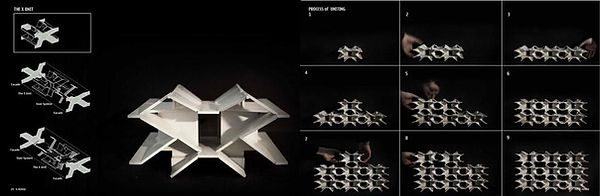
X-house
Essentially, residing in a basement apartment is only a temporary solution, therefore the residence should more or less serve as a trigger for its occupants to widen their social circle. According to our research, there are two categories that all activities within the unit may be placed into Private Activities (sleeping, bathing, etc.) and Sharable Activities (eating, reading, relaxing, etc.). The success of this endeavour depends on identifying the many topological links that might exist between these two categories. An X-like prototype is created by disassembling and rebuilding such relationships, and its Private Space is able to network well with other archetypal units while maintaining privacy. The typological relationship is transformed in a way that appears simple but is actually iterative.
The X-prototype is a model with four-quarters of sharable space in each of its four corners and a bedroom and bathroom in the centre. Similar to the way single humans live, the way this X-prototype could be aggregated suggests that the varied possibilities reside in the interactions among diverse single units. Another subject covered in this study is achieving varying levels of spatial connectedness. The extrusion and merging of a number of pieces with varying degrees of spatial connectedness might be viewed as the genesis of the X-prototype. The living situation at X-House will be unique. Each occupant may easily come to know everyone other in the building. In conclusion, the X-House optimizes the probability that residents will find their soul mates and eventually allows them to begin a new life outside the X-House rather than trying to persuade them to stay for the long haul. The X-House experience will be fleeting yet incredible.
"I wanted to combine adventurousness and disequilibrium, or: the pursuit of movement."
Claude Parent

Claude Parent & Paul Virilio


Parent and Virilio collaborated on works that expanded their views on "how the oblique operates in architecture." With these initiatives, they were telling people—aside from the few sailors and mountaineers who understood what they meant at the time—that they had been living on horizontal planes for nine thousand years without ever considering an alternative. All rational systems were eliminated in this radical rethinking of design. Buildings would transform into landscapes, and our perception of space would change to become more active rather than passive. There would no longer be enclosures or a sense of up and down. What could moving and being in space look like if climbing, lying down, and sliding were also acceptable means of locomotion?
I reviewed the architectural principle of Claude Parent and Paul Virilio, and I thought about how the inclined surfaces can allow deeper human relationships. This point would be mentioned in my work and presentation, so I need to explore and find a more concrete idea about this and find out how to implement the principle into this modular structured building. I found these sketches when googling Claude Parent, and for the left one, I think I can reference the way the author used to use ramps to form spaces and make the ramp not only a space but a partition between spaces with different functions. And the other sketch inspired me to like form circulation by breaking the boundaries of the frame structure. The frame, in a sense, limits the possibility of the cells, I think, so I might need to reconsider the meaning of the frame. I just thought I could make the frame as vertical transportation as well. The angle of the slopes is also too steep for the exterior stairs. I might need to reform the cell and reduce the angle of inclined walls. The communal spaces are just some more freely installed cells with multiple scales so far, so I think it is important to tease out the fundamental logic of communal spaces and how communal and private spaces connect.